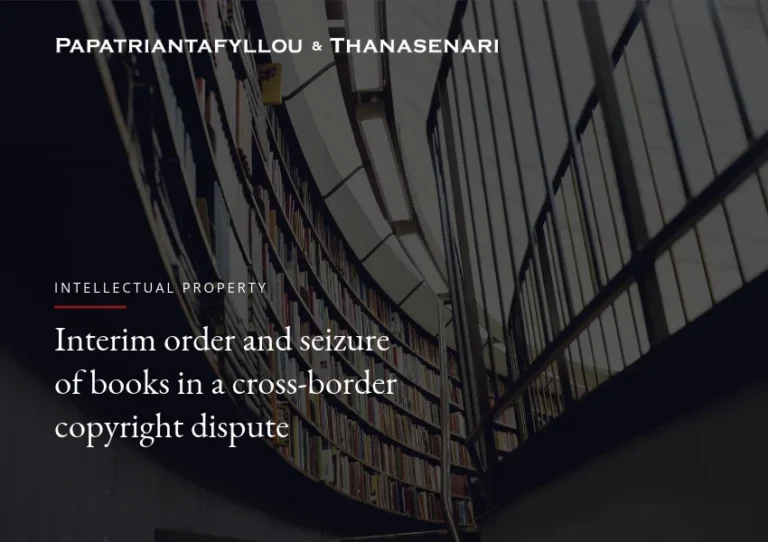
Interim copyright protection in Greece in a cross-border dispute
Papatriantafyllou & Thanasenari has obtained an interim order from the courts in Greece, securing copyright protection for an internationally acclaimed literary translator in a dispute with a well-known Greek publishing house. The case concerns the alleged unauthorised use of our client’s award-winning English translation as the basis for the Greek edition of the novel.
The interim order directed the precautionary seizure of copies of the disputed Greek edition held by the publisher at its premises, its bookshop and its warehouses. The order was promptly enforced and copies were seized, securing a tangible result already at the interim relief stage.
An award-winning work and the protection of its translation
The novel was first published in Taiwan. Our client produced its English translation, which received exceptional international acclaim and was honoured with leading literary translation awards in the United States and other jurisdictions, recognising both the literary merit of the work and the translator’s creative contribution.
Our client has registered her rights in the English translation with the U.S. Copyright Office, which records her as the author and claimant of the translated work. The registration expressly distinguishes the English translation from the pre-existing Mandarin Chinese original.
At the heart of the dispute lies the use of the English translation as the basis for the Greek edition. Our client brought proceedings before the Greek courts, asserting that her translation had been used without the required authorisation.
Under Article 2(2) of Greek Law 2121/1993, original translations are protected as independent works of authorship, without prejudice to the rights in the original work. A licence covering the original and permission to use a specific protected translation of it are therefore distinct matters. The distinction becomes critical where a new edition is produced from an intermediate translation rather than directly from the original.
A cross-border dispute spanning multiple legal systems
The path from the Taiwanese original to the English translation, its registration in the United States and the disputed Greek edition gives the case a genuinely international dimension. It brings together different languages, markets and legal systems, with the protection of the translator’s rights in Greece at its core.
Disputes of this kind call for an integrated assessment of the chain of title, the scope of the licences granted and the manner in which the protected work has been exploited. The international circulation of a book may involve several rightsholders and successive agreements, whose terms are decisive in assessing the disputed exploitation.
For authors, translators and businesses operating internationally, the protection of intellectual property goes hand in hand with control over the commercial exploitation of their work. The ability to seek court intervention in the jurisdiction where the disputed use takes place is a key component of that protection.
From interim order to seizure of copies
Once a disputed edition is already on the market, speed of response becomes critical. The gathering of evidence and the choice of the appropriate court remedy must reflect the actual conditions in which the work is being distributed.
In this case, our application led to interim protection in the form of a precautionary seizure. Enforcement was an integral part of our strategy: the protection granted by the court was immediately translated into the seizure of the copies located at the publisher’s premises.
Following the interim order and the seizure, the publisher announced that the publishing cycle of the book had come to an end. This development followed our firm’s intervention to protect our client’s copyright.
The international dimension of intellectual property
A work that circulates internationally carries with it a complex web of rights, licences and contractual relationships extending across several jurisdictions. Protecting it in Greece requires a precise analysis of that framework and the swift deployment of the remedies available under Greek law.
For those who create or do business across borders, control over the exploitation of their work is often determined in the country where it is made available, and it is precisely there that prompt court action becomes decisive. Representing a foreign author or rightsholder in Greece therefore calls for a thorough understanding of the international context of the dispute and the strategic use of the protective tools of the Greek legal system.